CURRENT GEO POLITICAL SCENE

CURRENT GEO POLITICAL SCENE

Sunday, December 19, 2021


The west should sink those illegal fishing of China as it avoids Kinetic warfare but indulge with media threats 


Western history can be seen as having several inflection points: one was 1492, the advent of the “Columbian Era”. The Columbian era is the era of sea-faring, sea-power-based Western colonial and imperial empires. The demise of the Columbian era, was foreshadowed by an Oxford geographer in 1904 who put forth what is now known as the “Heartland Theory”. In a nutshell, it is a land-based theory of power that predicts the end of sea-based powers: “Who rules East Europe (Eurasia) commands the Heartland; who rules the Heartland commands the World-Island; who rules the World-Island commands the world.” It also concluded, “Were the Chinese…to…conquer its territory [of the Russian Empire], they might constitute the yellow peril to the world’s freedom.” This maxim and the anxiety it provoked was red-lined in Brezinski’s “Grand Chess game”: “No Eurasian challenger should emerge that can dominate Eurasia and thus also challenge U.S. global pre-eminence.”


In 1992, Marshall’s protégé, Paul Wolfowitz formulated the above strands into a formal doctrine, in the above mentioned DPG (Defense Planning guidance) document:


“Our first objective is to prevent the re-emergence of a new rival… that poses a threat on the order of that posed formerly by the Soviet Union…to prevent any hostile power from dominating a region to generate global power…The U.S. must… protect a new order that [convinces] potential competitors that they need not aspire to a greater role or pursue a more aggressive posture to protect their legitimate interests. In non-defense areas, we must… discourage them from challenging our leadership or seeking to overturn the established political and economic order. We must maintain the mechanism for deterring potential competitors from even aspiring to a larger regional or global role.”


This can be better understood by looking at a map:


This is a map of the world, drawn from a topologist’s eye. It shows relationships, not distances or area. From this map you can note the following things:


+ China has more borders than any other country in the world. This also gives it the possibility of connecting with more countries than any other.


+ Blue lines/corridors are oceans: The top two thirds is the “world island” or “pivot state”–it contains most of the world’s population, resources, and wealth, and it can be connected as a single entity through overland routes or short ocean hops.


+ The bottom is the Americas. It is topologically isolated from the world island. As sea lane control becomes less important, it will also lose prominence and relative power if the world island unifies. It’s clear that that unifying power will probably arise in China, whose overland paths using high-speed rail, roads, pipelines, and ports can be easily built and connected, in a “new silk road”.


+ The US needs to fracture the world island to maintain its global power. If you color in the places where China is encircled, or where the US is waging war/fracturing societies/creating chaos, this is exactly where the fault lines of the global conflict are, and reveal what US strategy is.


Here is a second map:


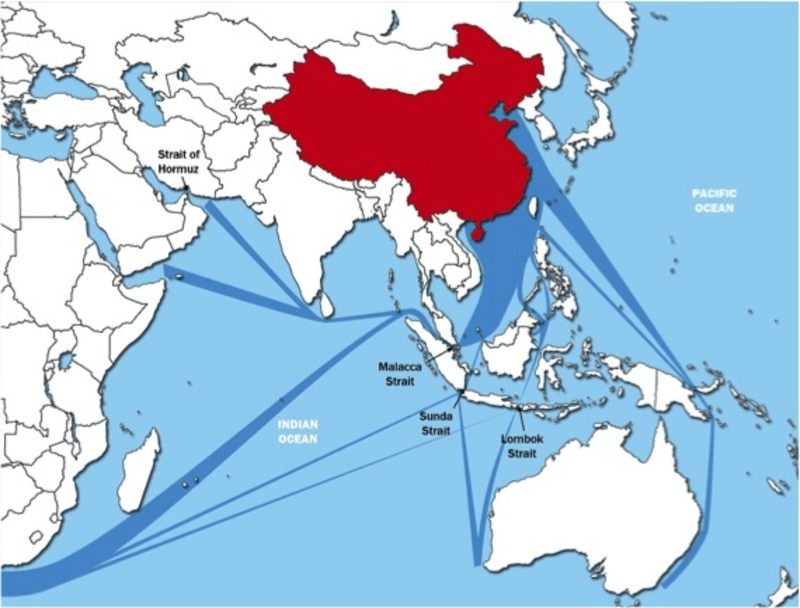
Image: CSBA: Shipping Lanes through the South China Sea.


The US has actually surrounded China with 400 military bases, bristling with strategic and tactical weaponry. It also has war-gamed out China’s key vulnerability: the chokepoint of the South China Sea. War in the South China Sea would disrupt $5.3 Trillion of China’s external trade and 77% of China’s oil imports[5]. In this scenario, the US does not have to win a shooting war with China in the South China Sea. The war just has to happen, and the disruption to trade could crash China’s economy. The map shows the shipping lanes that would be disrupted.


China’s first response to the US pivot and encirclement, especially in the South China Sea–its key chokepoint–was to build defensive military facilities along some of the islands, to deter US incursion and to raise the cost of interference. Its other response, much more ambitious, was the Belt & Road Initiative (BRI), which constitutes a long overland escape from the encirclement, similar to its “long march” during its encirclement by the fascist KMT. The BRI travels through SE Asia, then overland through Central Asia, to the Mediterranean, and then Europe and Africa. In particular:


+ CMEC (China-Myanmar Economic Corridor) travels through Rakhine State and exits to the Indian Ocean at Kyaukphyu port (bypassing the Strait of Malacca).


+ CPEC (China-Pakistan Economic Corridor) to Gwadar port transits directly to the Arabian Sea and the Persian Gulf.


+ Xinjiang is the key overland route for BRI to exit China to Central Asia, with Iran also a key node.


+ Djibouti at the horn of Africa is the entry node to Africa (the Sahel, and the South)


BRI as it does this, becomes the physical realization of Mackinder’s “heartland” in Eurasia—the pivot state connecting the “world island” into a single economic bloc, and raising China to the status of the key regional power, exactly what Brezinski and Wolfowitz, sought to prevent.


Image: Mercator Institute for China Studies: Belt and Road Initiative.


Mindful of this development, and aware of the rapidly ticking biological clock on US power, the US is currently rapidly escalating hostilities in the SCS, most recently with war games, U2 incursions, belligerent passages of aircraft carriers, guided missile destroyers, submarines; China’s response has been to launch “carrier killer” missiles into the region.


In December 2018, Rear Admiral Lou Yuan of the PLA Navy said, ‘What the United States fears the most is taking casualties,’ and suggested that sinking two US aircraft carriers would be sufficient to expel the US from the South and East China seas. ‘We’ll see how frightened America is.’

The authors say that using this concept of ‘offensive deterrence’ by conducting strikes that kill Americans or Australians would not have the deterrent effect the PRC seeks or expects ‘and the risks of escalation from such a deterrent effort are extremely high’.

So, they say, planners must take this into account both when seeking to deter China as well as when thinking through what actions it might take or how it might react to our actions.

In examining how China might be deterred from actions inimical to international goals and standards, the report contains various definitions of what deterrence actually is. One is that of strategist Thomas Schelling, described as the contemporary father of coercion theory: ‘To be coercive, violence has to be anticipated. And it has to be avoidable by accommodation. The power to hurt is bargaining power. To exploit it is diplomacy—vicious diplomacy, but diplomacy.’


Zhao Xijun of the PRC’s National Defense University defines ‘offensive deterrence’ in his book Coercive warfare: a comprehensive discussion on missile deterrence as ‘a military deterrence that mainly aims at attacking’ and writes that ‘the characteristic of offensive deterrence is to use “pre-emptive strike” to deter the other side’. Zhao also states that this concept is ‘“using war to stop war” by [using] small war to constrain large war’.

The authors compare the current situation to the way the US and the Soviet Union related to each other during the Cold War. Apart from contact at organisations such as the United Nations, the two sides had little interaction, little trade, little commerce and relatively little overlap in their geographical spheres of influence.

‘There was tension and conflict on the margins with clear escalatory potential, but the two sides managed to avoid direct or large-scale confrontations, albeit narrowly at times. That was in large part because the two sides developed a shared basic understanding of the world.’

Everyone in the military and the broader defence and security establishment knew something about the Soviets and their military. People studied what the Soviets thought, how they spoke and the actions that they took, down to the smallest details.

Each side developed a solid basis for understanding the signals the other side was sending, and typically sent clear signals of its own.

The authors say that that is not the case today.

‘The CCP’s understanding of the world, and thus its approach to it, is significantly different from Western views. It’s neither right nor wrong, just a different perspective, and one that isn’t common in Western liberal democracies; nor is it commonly taught in Western education systems, or indeed even in professional military education.’

They say that Australian and US partners and allies such as Japan, South Korea, Singapore and Taiwan have a historical appreciation and can help contribute to a better understanding of historical concepts. But, since 2001, the US and many of its partners have been focused on fighting terrorist groups and managing the conflicts in Iraq, Afghanistan and the broader Middle East.

Only during the latter part of the Trump administration did the US truly focus the whole of government on addressing the competition with China, bringing in Congress as well as the military, the State Department, the Committee on Foreign Investment in the United States and others.

While it takes years to build a deep and wide group of specialists in any field, the authors say, it stands out that the US Air Force has the same number of foreign area officer places for Chinese specialists as it does for Portuguese speakers.

They warn that if the US and its allies and partners hope to avoid conflict with China, they must build a deeper shared understanding of how the CCP and the PRC see the world. That will require sustained effort over several years and involve a deep partnership with partners and allies who have vital knowledge and expertise.

They also urge planners not to ‘mirror ourselves onto our analysis of PRC thinking and action’.


They say that: ‘With sustained effort, we can do better at understanding Chinese thought and concepts and the twists that CCP ideology gives them. In that way, we can maximise our opportunities to ensure that our strategic goals are met and our interests are protected.’

Friday, December 03, 2021


Where the housing market is going in 2022 as told by 7 leading forecast
models


A perfect storm. That's the best way to describe the red-hot housing market we've seen from coast-to-coast during the pandemic. It was spurred by a combination of recession-induced low mortgage rates, remote work allowing buyers to sprawl further away from their workplace, and a demographic wave of first-time millennial homebuyers entering into the market. Of course, years of under-building means there simply aren't enough homes available to meet this demand. Cue record price growth.


But how much longer will this run last? After all, home price appreciation of 19.9%—a 12-month record set between Aug. 2020 and Aug. 2021—can't be sustained forever.

Already, there are signs the housing boom is losing some steam. We're seeing seasonality—a cooling period that happens like clockwork most years—return to the market after it was absent during the holiday and vacation stretch last year. That's not all: More homebuyers are finally beginning to push back against surging prices. Indeed, in October 60.3% of sales involved a bidding war, which is down from the all-time high in April (74.5%). There's also the increased likelihood the Federal Reserve will raise rates to tamp down inflation. Rising mortgage rates would price out some buyers altogether.


What does this mean for home price growth in 2022? To find out, Fortune reviewed seven industry forecast models. But buyers and sellers alike won't get much peace of mind from these forecasts: The economic models don't produce anything close to a consensus. Some of these forecast models predict price growth next year will go down as one of the highest on record. Others are forecasting a rate of appreciation that would be the slowest in more than a decade.


Let's take a look at these models—and also look at why there's so much uncertainty heading into next year.


On the high end of the spectrum are Zillow and Goldman Sachs. Zillow projects home prices will rise 13.6% between Oct. 2021 and Oct. 2022. Meanwhile, Goldman Sachs forecasts a 16% uptick between Oct. 2021 and Dec. 2022 (or 13.5% on an annualized basis). For perspective, the largest 12-month uptick in the lead up to the 2008 housing crash was 14.1%. Simply put: Researchers at both Zillow and Goldman Sachs see priced out buyers falling further behind next year.


“The supply-demand picture that has been the basis for our call for a multiyear boom in home prices remains intact...Of all the shortages afflicting the U.S. economy, the housing shortage might last the longest," wrote Goldman Sachs in its 2022 outlook.

What's going on? Well, neither Zillow nor Goldman Sachs foresees the demographic wave of first-time millennial homebuyers letting up. We’re in the midst of the five-year period (between 2019 and 2023) in which the five largest millennial birth years (between 1989 and 1993) are hitting the all-important first-time home buying age of 30. According to their forecasts, there won't be enough homes to satisfy all of that demand next year.

Since 1980, Fortune calculates home prices on average have climbed 4.6% per year. Over the past year, price growth (19.9%) is four times that level.


The good news for would-be home buyers? Among the seven forecast models Fortune examined, four predict we'll see price growth in 2022 fall back closer to the historical average. That includes Fannie Mae and Freddie Mac, which are predicting U.S. home price growth of 7.9% and 7%. That's slightly higher than the historical norm, however, it's hardly the eye-popping numbers we've seen during the pandemic. Meanwhile, models released by Redfin and CoreLogic foresee 12-month price growth falling to 3% and 1.9%, respectively.

What do the models predicting substantial price deceleration have in common? They foresee price growth getting chopped down by rising mortgage rates. As of Monday, the average 30-year fixed mortgage rate stands at just 3.1%. By the end of 2022, Fannie Mae projects it'll hit 3.4% while Redfin's model says 3.6%. Those jumps are bigger than they might appear at first glance. Let's say a borrower took on a $500,000 mortgage. At a 3.1% mortgage rate, they'd see a $2,135 monthly payment (not factoring in any taxes or insurance). But if that rate were the 3.6% as projected by Redfin, that payment would rise to $2,273—or nearly an additional $50,000 over the course of the 30-year mortgage.

Another unknown: Will corporate America begin pushing harder next year to bring staffers back into the office? If the workplace is less WFH friendly next year, that could translate into fewer buyers in both second home markets (like the Hamptons) and in the exurbs. That concern is shared by Frank Martell, CEO of CoreLogic, who wrote in the real estate data firm's latest forecast that "as we head into 2022, we expect some moderation in the current pattern of flight away from urban cores as the pandemic wanes.”

But there is one outlook that is relatively bearish on price growth.

The Mortgage Bankers Association, an industry trade group, is predicting that the median price of existing homes will decrease by 2.5% between the fourth quarter of 2021 and the fourth quarter of 2022. When you look closely at its model, it's easy to see why: The Mortgage Bankers Association is forecasting that the average 30-year fixed mortgage rate will hit 4% by the end of 2022. Over the course of 30 years, that'd add an additional $90,000 in cost to a $500,000 fixed rate mortgage


That said, even if the Mortgage Bankers Association's price drop comes to fruition, it'd hardly be a housing crash. In fact, in that scenario, U.S. home prices would still be up over 20% from pre-pandemic levels.


Thursday, December 02, 2021


GEOPOLITICS OF FRANCE: WILL MACRON MAKE EUROPE A SUPER POWER


The 21st century brings great changes for the world order. The French recognize these and want Europe to keep up with the US and China. Will France lead Europe towards a superpower? Welcome to the next episode of The 20s Report.


How President Macron plans to capture Africa's demographic wave by using the French language, with the ultimate goal to cement French hegemony worldwide. BAKU - For centuries, France was a global powerhouse, permeating its will over five continents. Since those imperial days, it has lost considerable ground in its former domains. Only in Africa did France retain its hold, owing to the monetary system that was put in place. In the decade after World War II, President François Mitterand was quoted saying: “Without Africa, France will have no history in the 21st century.” Like a foretelling coming true, it is precisely because of Africa that modern-day France is returning as the global force it once was. And it’s using the soft power attributes of language to cement its hegemony


Can Macron lead the European Union after Merkel retires?
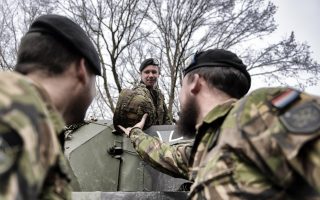
Troops from a European tank battalion that consists of Dutch and German soldiers prepare for an exercise near Oldenburg in northern Germany on Feb. 4, 2019. 


After Germans vote Sunday and a new government is formed, Chancellor Angela Merkel will leave office after 16 years as the dominant figure in European politics. It is the moment that French President Emmanuel Macron has been waiting for.


The German chancellor, although credited for navigating multiple crises, was long criticized for lacking strategic vision. Macron, whose more swaggering style has sometimes ruffled his European partners — and Washington — has put forward ideas for a more independent and integrated Europe, better able to act in its own defense and its own interests.

But as the Anglo-American “betrayal” in the Australian submarine affair has underscored, Macron sometimes possesses ambitions beyond his reach. Despite the vacuum Merkel leaves, a Macron era is unlikely to be born.

Instead, analysts say, the European Union is heading for a period of prolonged uncertainty and potential weakness, if not necessarily drift. No one figure — not even Macron or a new German chancellor — will be as influential as Merkel was at her strongest: an authoritative, well-briefed leader who quietly managed compromise and built consensus among a long list of louder and more ideological colleagues.


That raises the prospect of paralysis or of Europe muddling through its challenges — on what to do about an increasingly indifferent America, on China and Russia, and on trade and technology — or even of a more dangerous fracturing of the bloc’s always tentative unity.

And it will mean that Macron, who is up for reelection in April and absorbed in that uncertain campaign, will need to wait for a German government that may not be in place until January or longer, and then work closely with a weaker German chancellor.

“We’ll have a weak German chancellor on top of a larger, less unified coalition,” said Mujtaba Rahman, managing director for Europe of the Eurasia Group, a political risk consultancy. “A weaker chancellor is less capable of exerting influence in Europe, and then with the Macron election, the political cycles of these two key countries will not be in sync.”

The uncertainty is likely to last until after the French parliamentary elections in June — and that is presuming Macron wins.


Macron has argued forcefully that Europe must do more to protect its own interests in a world where China is rising and the United States is focusing on Asia. His officials are already trying to prepare the ground on some key issues, looking forward to January, when France takes over the rotating EU presidency. But given the likelihood of lengthy coalition talks in Germany, the window for accomplishment is narrow.

Macron will need German help. While France and Germany together can no longer run the European Union by themselves, when they agree, they tend to bring the rest of the bloc along with them.

So building a relationship with the new German chancellor, even a weaker one, will be a primary goal for Macron. He must be careful, noted Daniela Schwarzer, executive director for Europe and Eurasia of the Open Societies Foundations, not to scare off the Germans.

“Macron’s leadership is disruptive, and the German style is to change institutions incrementally,” she said. “Both sides will need to think through how they make it possible for the other side to answer constructively.”

French officials understand that substantive change will be slow, and they will want to build on initiatives already underway, like the analysis of Europe’s interests called “the strategic compass” and a modest but steady increase in military spending on new capabilities through the new European Defense Fund and a program called Pesco, intended to promote joint projects and European interoperability.

After the humiliation of the scuttled submarine deal, when Australia suddenly canceled a contract with France and chose a deal with Britain and the United States instead, many of his European colleagues are more likely now to agree with Macron that Europe must be less dependent on Washington and spend at least a little more in its own defense.

Few in Europe, though, want to permanently damage ties with the Americans and NATO.

“Italy wants a stronger Europe, OK, but in NATO — we’re not on the French page on that,” said Marta Dassu, a former Italian deputy foreign minister and director of European affairs at the Aspen Institute.

Italian Prime Minister Mario Draghi, whose voice is respected in Brussels, believes strongly in the trans-Atlantic relationship, Dassu said, adding, “We’re closer to Germany than to France, but without all the ambiguities on Russia and China.”

France also wants to become more assertive using the economic and financial tools Europe already has, especially trade and technology, the officials say. The point, they say, is not to push too hard too fast, but to raise the European game vis-à-vis China and the United States, and try to encourage a culture that is comfortable with power.

But France’s German partners will be going through a period of uncertainty and transition. A new German chancellor is expected to win only one-quarter of the vote and may need to negotiate a coalition agreement among three political parties. That is expected to take at least until Christmas, if not longer.

The new chancellor will also need to get up to speed on European issues, which barely surfaced in the campaign, and build credibility as the newcomer among 26 other leaders.

“So it’s important now to start thinking of concrete French-German wins during a French presidency that Macron can use in a positive way in his campaign,” Schwarzer said. “Because Berlin does not want to ponder a scenario in which Macron loses” to far-right Marine Le Pen or in which euroskeptics like Matteo Salvini take over in Italy.

Whoever wins, German policy toward Europe will remain roughly the same from a country deeply committed to EU ideals, cautious and wanting to preserve stability and unity. The real question is whether any European leader can be the cohesive force Merkel was — and if not, what it will mean for the continent’s future.

“Merkel herself was important in keeping the EU together,” said Ulrich Speck of the German Marshall Fund. “She kept in mind the interests of so many in Europe, especially Central Europe but also Italy, so that everyone could be kept on board.”

Merkel saw the European Union as the core of her policy, said a senior European official, who called her the guardian of true EU values, willing to bend to keep the bloc together, as evidenced by her support for collective debt, previously a German red line, to fund the coronavirus recovery fund.

“Merkel acted as mediator when there have been a lot of centrifugal forces weakening Europe,” said Thomas Kleine-Brockhoff, head of the Berlin office of the German Marshall Fund. “It’s less clear how the next chancellor will position himself or herself and Germany.”

Still, Mark Leonard, director of the European Council on Foreign Relations, noted that “whoever is the chancellor, Germany is still responsible for more than half of Chinese trade with Europe.” Germany is “vastly more important than the other countries on all the big issues, from how to handle China to the tech wars and climate change,” he said.

That means Macron “knows he has to channel German power behind his vision,” he said.

But French and Italian positions will be crucial, too, on important pending financial issues like fiscal and banking integration, trying to complete the single market and monitoring the pandemic recovery fund.

Merkel’s departure may provide an opportunity for the kinds of change Macron desires, even if in vastly scaled-down version. Merkel’s love of the status quo, some analysts argue, was anachronistic at a time when Europe faces so many challenges.

Perhaps most important is the looming debate about whether to alter Europe’s spending rules, which in practical terms means getting agreement from countries to spend more on everything, from defense to climate.

The real problem is that fundamental change would require a treaty change, said Guntram Wolff, director of Bruegel, a Brussels research institution. “You can’t have fiscal and defense integration by stealth,” he said. “It won’t have legitimacy and won’t be accepted by citizens.”

But the German election debates ignored these broad issues, he said.

“The sad news,” Wolff said, “is that none of the three chancellor candidates campaigned on any of this, so my baseline expectation is continued muddling forward.”

Who will lead Europe after Merkel? Presidents and prime ministers jockey for the job.

German Chancellor Angela Merkel prepares to lead the last cabinet meeting of the German government ahead of the national elections.

As Germany prepares to elect its next chancellor Sunday, Europe is readying itself for a major shake-up of the unofficial hierarchy of continental leaders.


In nearly 16 years at the helm of Europe’s largest economy, Angela Merkel became the de facto representative on the world stage and the European Union’s chief power broker through countless late-night negotiations and a string of crises.


Germany will continue to wield immense influence. However, Merkel’s experience and reputation give her clout that none of her potential successors as chancellor could hope to match anytime soon. And so her departure will create an opening — for the first time in more than a decade — for other leaders to assert themselves and their vision for Europe.


A few favorites have emerged in the competition. French President Emmanuel Macron, head of the European Union’s second-biggest economy, has been jockeying for years to be the next leader of Europe. Italian Prime Minister Mario Draghi, best known for saving the euro while president of the European Central Bank, also has several of the necessary credentials.


But analysts, politicians and diplomats tend to agree that no one person is capable of filling Merkel’s loafers. Instead, they say, it will probably involve a coterie of premiers — probably all of them men.


“Merkel’s exit creates a problem with leadership, a hole at the heart of Europe,” said Giovanni Orsina, director of Luiss Guido Carli University’s School of Government in Rome. “Either the new chancellor fills that void, or we need to conceive of a collective convergence.”


After 16 years, Germany’s Merkel is stepping down. Here’s how she built her legacy.


There will be a marked shift in the balance of power, said a senior E.U. diplomat, and other European leaders will have to step up.


“This cannot only be done by one. It has to be done by the group,” he said, speaking on the condition of anonymity to discuss the sensitive political situation.


Merkel isn’t expected to leave office immediately after the election. The results are likely to be messy, and coalition talks could go through the end of the year — or beyond. Merkel would stay on as a caretaker until a new government is formed.


And then? Whoever steps into the job — the candidates include Armin Laschet, Olaf Scholz and Annalena Baerbock — would need time to settle in, and to establish themselves, before they could expect to command the sort of attention that Merkel has in Europe and internationally.


“Any German chancellor will move into a powerful position,” said Daniela Schwarzer, executive director for Europe and Eurasia at the Open Society Foundations. “Any next German chancellor will bring some experience and bring the same weight of the country to the table, but the personal weight will not be the same.”


What you need to know about Germany’s election


If Britain were still in the European Union, some of the power might shift across the English Channel. But in a post-Brexit world, London cannot expect to speak on behalf of the continent.


So, many heads are turning toward Paris.

German Chancellor Angela Merkel and French President Emmanuel Macron meet for a working dinner at the Élysée Palace in Paris on Sept. 16. (Ludovic Marin/AFP/Getty Images)


“The German elections are being seen in France as an opportunity for a reset, where whoever comes in will have less stature than Macron does and whereby France’s influence in Europe would be increased,” said Nicholas Dungan, a senior fellow at the Atlantic Council.


Macron has been preparing for this moment. He has repeatedly sought to emphasize his foreign policy experience, drawing a contrast with the German chancellor candidates, who spent most of their televised debates bickering about domestic politics.


Macron also has spent years outlining his vision for Europe.


In 2017, after another German election, he delivered a sweeping speech at Sorbonne University, arguing that the best response to ascendant nationalists was to acknowledge the European Union’s shortcomings — it is “too weak, too slow, too inefficient” — and then to work to make it stronger and more united.


He has reprised the theme many times. But his proposals — to integrate European defense, reform the euro zone, develop a common asylum policy and impose a new tax on U.S. tech giants — have not been enthusiastically embraced.


French ambassador to return to Washington as Biden, Macron seek to mend rift


The French president has lately been using the chaotic Afghanistan withdrawal, and a fight with the Biden administration over a nuclear submarine deal, to reiterate a call for European “strategic independence.” Other E.U. leaders have said they stand with France in the submarine spat, and they are equally frustrated about Afghanistan. Still, the idea of an E.U. military is far from becoming a reality.


Macron’s mandate as Europe-wide leader may depend in part on how much progress he makes when France takes over the Council of the European Union’s rotating six-month presidency in January — as well as on his showing in France’s presidential election in April. His main competitor, far-right leader Marine Le Pen, has a radically different view of the European project.


“To the question who will take the mantle, you already know the answer: It will be Macron,” an E.U. diplomat said, speaking on the condition of anonymity to offer a candid assessment. “The next question is: Will he retain the mantle?”


The determining factor, the diplomat said, may be whether Macron can learn to compromise.


“Macron has the tools and the chance to, for now, fill that void,” the diplomat said. “But he will only stay there in that position if he manages to bridge the gap between him and his way of doing things, and the east and the north and everybody else. That was Merkel’s way.”


Does the European Union need its own army? Afghanistan withdrawal revives an old debate.


Merkel’s critics, however, sometimes hold that against her. They say she delayed decisions at the E.U. level in an effort to preserve consensus and avoid conflict — and while doing so allowed for the erosion of democratic norms in countries such as Hungary and Poland. Her approach even earned its own verb: “Merkeln,” meaning to dither or bide one’s time.


“During the Merkel era, one always tried to handle and solve things among the 27, often postponing until the very last minute the required solutions for Europe, because of Merkel’s conviction that results could only be yielded by standing together,” said Sandro Gozi, a veteran Italian politician who now represents France in the European Parliament as part of Macron’s centrist “Renaissance” list.


“I believe Macron and Draghi can make all the difference here,” Gozi said.

Italian Prime Minister Mario Draghi, left, and French President Emmanuel Macron walk together before a dinner in Marseille, France, on Sept. 2. (Ludovic Marin/AP)


The French president and Italian prime minister were dubbed Europe’s “new power couple” by Politico in July, amid reports of a transalpine bromance. The two men, separated in age by 30 years, are both former investment bankers and longtime E.U. boosters, and have similar goals for the 27-nation bloc, especially on fiscal policies, where both favor further financial integration.


“I believe that in this new phase, leadership could be collective,” Gozi said. “I see Macron and Draghi as protagonists of that.”


At first, their leadership of Europe would be “two-legged,” Gozi said, but it would eventually include the new German chancellor. Indeed, many observers expect Macron would need strong German partnership to execute the most ambitious of his plans. But Gozi said the result would be “less Merkel-ian” — with faster action and less caution.


Germany’s Merkel makes final campaign push for stumbling political heir


Draghi has been positioning himself to take on a greater leadership role, observers say. He was a prominent voice in Europe’s reaction to the Afghanistan withdrawal, pushing for an emergency summit of the G-20, criticizing the European Union’s disorganized stance on accepting refugees, and calling President Biden during the evacuation efforts. In March, Draghi made headlines when he blocked the export of a batch of AstraZeneca coronavirus vaccine doses from the European Union amid a shortage inside the bloc. And he has been talking of using nearly $235 billion in E.U. money to enact an “epochal” pandemic recovery.

But his own sway may be limited by the size and influence of his country.


“The problem across history is not only who you are but the kind of car you’re driving,” said Orsina, of Luiss Guido Carli University. “Some things you can only do if you’re Germany, otherwise it’s that much harder, regardless of the leader’s personality.”


A number of other leaders will be elbowing for a more important role, including Spanish Prime Minister Pedro Sánchez and Dutch Prime Minister Mark Rutte. Both share one obvious trait with their counterparts in France and Italy: They’re men.


After Merkel’s departure, council summits risk taking on the feel of an old boys’ club, said Open Society’s Schwarzer.


“There’s a certain element of having a female leader at the table — the balance will shift in that regard, as well, and that does make a difference in group dynamics,” she said. “Not only what happens in the room but the reception of politics.”


Some Europeans are sure to welcome Merkel’s egress as a chance for potential realignment and more substantive reforms to the European Union.


The Merkel era “has led to a Europe that is highly dependent on Germany and Germany’s choices,” said Rosa Balfour, the director of Carnegie Europe. “The gravity of power has shifted to Berlin, and it hasn’t been all for the good of the rest of Europe. If there’s a slight change in the balance of power, tipped in the favor of a broader pioneering group, from a European perspective there could be benefit in that.”


Critics argue, for instance, that Germany’s response to the euro-zone debt crisis and its push for austerity measures did deep and lasting damage to Greece and Italy, Balfour said.


Still, Merkel’s support remains strong across the continent — yet another indicator of how difficult she will be to replace. A recent survey by the European Council on Foreign Relations asked residents in 12 E.U. nations who they would vote for in a hypothetical election for president of Europe, Merkel or Macron.

Wednesday, December 01, 2021


GEOPOLITICS OF ROMANIA


US army tanks and soldiers continued being deployed on Tuesday to an air base in southern Romania, after the first shipment of tanks had arrived the day before. The tanks were offloaded from a train in the village of Mihail Kogalniceanu, where they would be taken to a nearby military air base. The deployment, known as Operation Atlantic Resolve, is part of an American operation to reassure NATO allies and other partners concerned about Russia. Five hundred US soldiers will eventually be deployed at the Mihail Kogalniceanu Air Base in Constanta County. The operation foresees the continuous presence of an American armoured brigade combat team in Europe on a nine-month rotational basis.


US to Turn Romanian Airbase into NATO Black Sea Hub


A $152 million US-funded construction project will turn the former Soviet base of Campia Turzii in central Romania into new major hub for NATO aircraft in the Black Sea region.


A US Air Force F16 jet takes off during the joint Romanian-US military drill ‘Dacian Viper 2014’ at the Campia Turzii military airbase, April 2014. Archive photo: EPA/MIRCEA ROSCA

The US Air Force will this month start awarding contracts for construction work to upgrade the Campia Turzii base, enabling it to support heavy cargo aircraft and host fighter jets, boosting NATO’s capacities in the Black Sea area.

“We are getting ready to award four projects for construction between May and August 2021,” Darren Walls, a design and construction program manager at the European Deterrence Initiative launched by the US after Russia’s annexation of Crimea in 2014, said in a US Air Force statement quoted on Tuesday by Romanian media.

“The upgrade is important because Romania needs to boost its capacity to receive further NATO aircraft in case of a crisis or conflict that require a collective response,” former Romanian official and security expert Claudiu Degeratu told BIRN.

“Romania also needs a second major air base that meets NATO standards so it can serve its newly acquired F-16 jets,” Degeratu added.

He said that Russia’s buildup of troops around the Ukrainian border in April “shows that a quick renovation of the Campia Turzii base is needed”.

Romania and its US allies already have a large NATO airbase at Mihail Kogalniceanu near the Black Sea. The improvements at Campia Turzii will increase the US and NATO’s capabilities to respond to any potential threats and deter Russia in the region.

US Navy Captain Scott Raymont, the US European Command’s Logistic Directorate chief engineer, explained recently that the reconstruction works at Campia Turzii “include the construction of airfield infrastructure and supporting facilities necessary”.

This will enable the base “to sustain the [US] Air Force’s combat operation and surveillance missions while increasing logistics capabilities in the theatre”, he added.

Following Russia’s annexation of Crimea, the Black Sea has become a strategic priority for the US and NATO defence in Europe, as the Kremlin has heavily increased its activity and presence near the Western military alliance’s south-eastern flank.

As a result, the US and Romania have intensified their military cooperation. Former US President Donald Trump’s administration planned to redeploy some of the US troops he ordered out of Germany last year to Romania and Poland – a move welcomed by Romanian and Polish officials.

On May 10 this year, leaders of Central and Eastern European NATO member states met in Bucharest to discuss the recent mass deployment of Russian troops near the Ukrainian border.

“I advocated a bigger presence of the alliance and the US in the south of the [NATO] eastern flank,” Romanian President Klaus Iohannis said he told his US counterpart Joe Biden, who took part in the summit remotely.

Security analyst Degeratu said this was “a message to Biden so he continues Trump’s policy to redeploy troops in the region”.

Romania Unveils Patriot Missile System on Black Sea


Romania has become the first country to have a Patriot surface-to-air missile system in the Black Sea region, an area where Russia is increasingly perceived as a growing threat by Romania, the US and their NATO allies.


The Patriot surface-to-air missile system unveiled today in the Cape Midia, Romania. Photo: BIRN

Romania on Thursday received the first Patriot surface-to-air missile system acquired from US defense giants Raytheon and Lockheed-Martin, which has been hailed as a crucial step towards strengthening the country’s air defences in the Black Sea region, where Russia is increasingly active.

“The set-up of the first Patriot system is only a first step towards building a formidable air defence capability for our country, which will significantly contribute to consolidating deterrence and the defence of NATO on its eastern flank,” Romania’s Defence Minister, Nicolae Ciuca, said at the unveiling ceremony at the Cape Midia military base near the Black Sea port of Constanta.

Following the arrival of the first Patriot missile system, the Romanian military will receive another three missile systems in future. The remaining three missile systems will be delivered from 2022, military sources told BIRN.

Speaking at Cape Midia, the US ambassador to Bucharest, Adrian Zuckerman, saluted the acquisition of the Patriot system as a stride towards Romania becoming capable of defending itself and its NATO allies from threats. He singled out Russia and China among these threats.


Romania is the seventh NATO country to acquire Patriot missile systems, the first in the Black Sea region and the second in Eastern Europe after Poland.

Globally, Romania is the 17th country to buy this US-built defence technology – Patriot being the acronym of Phased Array Tracking Radar to Intercept on Target – and which is capable of intercepting aircraft and both cruise and ballistic missiles.


“The acquisition of these systems solves a big problem for Romania’s national defence system,” military expert Claudiu Degeratu told BIRN. “We inherited only missile systems produced in the former USSR; Romania did not acquire anything of relevance in this field after [the advent of democracy in] 1990,” he added.

Degeratu explained that the purchase of the Patriot systems should be seen in the light of Russia’s “accelerated militarization of the peninsula of Crimea following its annexation of this region”, from Ukraine in 2014.

“The Russian Federation has deployed new fighter aircraft, new modern missile systems, and warships equipped with short, medium and long-range missiles, including supersonic and submarine missiles,” the same expert said.

In recent years, Romania has stepped up its defence capabilities in order to deter Russian advances in the region following the seizure of Crimea.

Since then, Russia has significantly increased its military might in the Black Sea, which Romania and its allies in NATO perceive as a threat.

These and other geopolitical developments have turned Romania into a cornerstone of US and NATO defence strategy in Europe.

Following the withdrawal of nearly 12,000 US troops from Germany, US officials have announced an intention to redeploy some them to Poland and Romania, to reinforce deterrence of Russia on NATO’s eastern flank.

The US already has two military bases in Romania and is planning to invest in turning the former Soviet airbase of Campia Turzii in Transylvania into a major hub from which to boost reconnaissance patrols over the Black Sea.


Monday, November 29, 2021

p> 


The Philippines is a frontline of another cold war


Like in the Cold War, the United States is attempting to contain the influence of a great power rival in Southeast Asia. To counter China, the United States' approach to its relationship with the Philippines invokes déjà vu. Despite the passing of decades, the players, strategy and results remain the same.

First, the players. Many who have studied U.S.-Philippines relations during the Cold War focus on the relationship between President Reagan and the infamous Philippine dictator Ferdinand Marcos. This is because Ronald Reagan was the quintessential "cold warrior" whose administration attempted to counter communist influence by supporting U.S.-aligned dictators the world over.


What gets less attention is President Carter's own complicity in propping up the Marcos regime. Carter, often categorized as a human rights-focused president, supported the Marcos regime after the declaration of martial law in the Philippines in an effort to keep U.S. access to military bases on the archipelago. While it is debatable whether Joe Biden is the new Jimmy Carter, he is a Democratic president who is claiming that his administration prioritizes human rights while navigating relationships with regimes that have dubious human rights records.

On the Philippines side, the comparison of President Rodrigo Duterte to Ferdinand Marcos is obvious: Duterte's drug war, encouragement of extrajudicial killings, shuttering of critical media and scoffing at international law echo the Marcos regime's myriad abuses. What's more, the children of both Marcos and Duterte are running on both parents' legacies in the Philippines presidential election.

Second, the strategy. The Philippines is, once again, seen as a geopolitically necessary bulwark against a superpower that threatens U.S. hegemony in the region. And again, the U.S. approach to containment is a prioritization of military superiority against China through access to bases on the Philippines.

To maintain access to these bases, the U.S. buys off the Philippine government with a steady stream of security assistance, turns a blind eye when atrocities are committed with said security assistance and reassures the Philippine government of lasting support whenever international or domestic criticisms are made.

Like in the first Cold War, the Philippine government is being given materials to engage domestic enemies, not foreign aggressors. Even with the most recently proposed arms sale of 10 F-16 fighter jets and a Harpoon Block II anti-ship missile system, the Philippines is no match for full-scale combat with the Chinese military and must rely on the military might of the U.S. to protect it. This approach does not foster sovereignty and self-determination; it leads to dependency and lackeyism.


Lastly, the results. In both cold wars, ordinary citizens at the crossroads of conflict were sacrificed. During the regime of Ferdinand Marcos, it is estimated that 3,257 people were murdered and 35,000 were tortured by the U.S.-backed Philippine security state. As of now, estimates put Duterte and his security forces' body count at approximately 30,000; this does not figure in the recent spate of killing human rights defenders. Along with Duterte's killings, his crackdown on critical media and political opposition mirrors Marcos's approach to dissent. As with most reigns of terror, we will not know the gravity or magnitude of the abuses committed until the regime has long disappeared.

What happened after Marcos's ouster was a critical reevaluation by the Filipino people of the Philippines' relationship with the United States due to the United States' unwavering support of Marcos.

As a result, the reawakened democracy voted in 1991 not to ratify a treaty that allowed the U.S. access to bases in the Philippines. It wasn't until 2014, with the signing of the Enhanced Defense Cooperation Agreement, that the U.S. was allowed to fully station bases in the Philippines. If the U.S. is determined to follow the exact same approach in the new cold war with regards to the Philippines, a similar backlash is bound to occur.

Setting aside the questionable utility of participating in another cold war, the United States owes it to the people of the Philippines not to repeat the mistakes we made in the first Cold War. This starts with distancing ourselves from human rights abusers who will cause more harm than good in the long term, and taking steps to demonstrate that human rights are a priority.

One substantial way to do this is to limit U.S. military aid to the armed forces of the Philippines and Philippine National Police. By withholding security assistance until perpetrators of human rights violations are held accountable for their actions, the U.S. creates an incentive for the government of the Philippines to develop a framework to address human rights concerns and gives the U.S. moral consistency when criticizing other states of human rights abuses.


Monday, November 01, 2021


War Preparation by US Against

Russia and China:Marines Seek  Anti Ship HIMARS

A renewed buildup of Russian troops near the Ukrainian border has raised concern among some officials in the United States and Europe who are tracking what they consider irregular movements of equipment and personnel on Russia’s western flank. At the same time USS Mount Whitney, the flagship of the United States Sixth Fleet, is heading for the #BlackSea. Analysts say the deployment of the warship to show support for #Ukraine. See the full story in the video.

Marine Corps photo

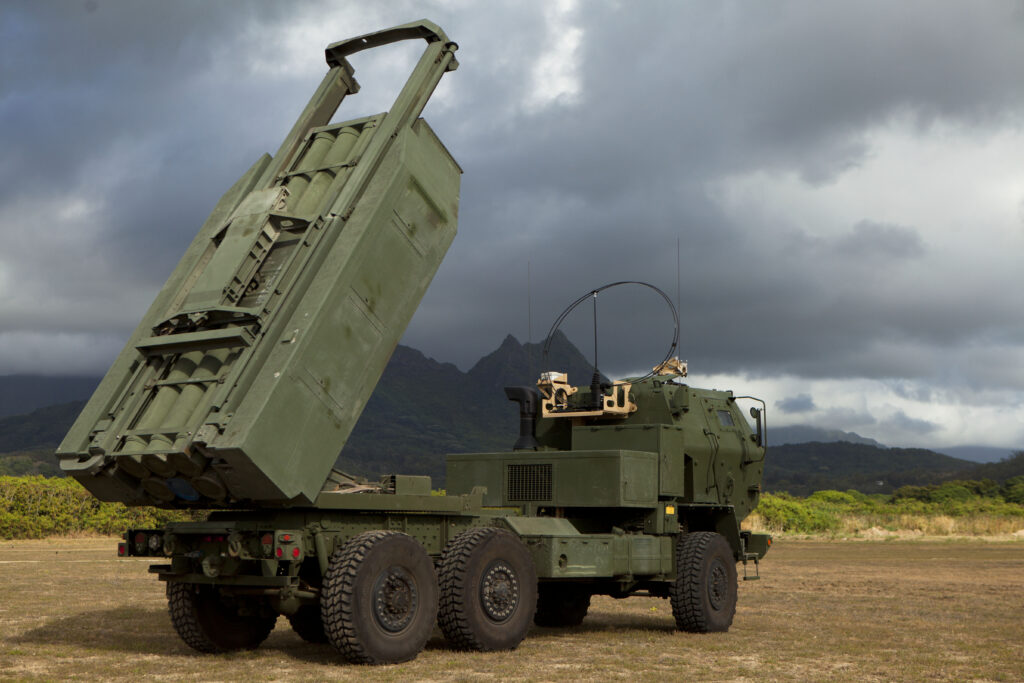
A Marine Corps HIMARS (High Mobility Artillery Rocket System)


For the first time since December 1941, when Wake Island’s shore gunners sank the invading destroyer Hayate, Marine Corps artillery wants to kill ships. That could be a big boost for the Navy, which confronts ever more powerful Russian and Chinese fleets.

Army artillery is also exploring anti-ship missiles, and the Marines may buy the same one. The difference is that it’s the Marines who work most closely with the Navy and who land in hostile territory to seize forward bases to support the fleet. That role makes Marines the first choice for the first wave, while the larger but slower Army provides backup.

courtesy NOAA

Imperial Japanese Navy destroyer Hayate, destroyed by Marine Corps shore batteries off Wake Island in 1941.

It also means the Marines need a highly mobile system that can come ashore with the grunts and keep moving to evade retaliatory fire while staying connected to Navy fire control networks. That’s a much more demanding mission than static coastal defense, the role of most anti-ship missile batteries around the world from Norway to Japan.

While the Marines haven’t committed to buying anything yet, they have requested information papers from industry, due on Nov. 30th, exploring a wide range of options. It might be the Army’s ATACMs, the Norwegian Naval Strike Missile, or something else. Based on interviews with four Marine officials, however, it’s clear they’d prefer a missile that can be fired from their existing HIMARS launcher, the truck-based High-Mobility Artillery Rocket System. Why? Because even if the Marines buy the minimum of new equipment for this new mission, it’s going to be “incredibly expensive” and tactically challenging.

For a small service like the Marine Corps, anti-ship missiles are “incredibly expensive,” said Kevin McConnell, deputy director of fires and maneuver on the Marine’s Combat Development & Integration staff. “Even if you consider (doing) a coordinated procurement with the Navy, it still becomes something far larger….than anything we’ve ever undertaken for ground (forces).”

Army photo

Army ATACMS missile launch.

A missile meant to find and a hit moving target, like a ship, is much more costly than one that just has to strike static GPS coordinates. Prices depend on variant and production run, but reported costs for the standard Guided Multiple Launch Rocket System (GMLRS) missile, used by both the Marines and Army, range from about $100,000 to $200,000 a shot. The larger Army Tactical Missile System (ATACMS), fired from the same HIMARS and MLRS launchers, costs roughly $750,000 to $820,000. In contrast, McConnell told me, “your bottom-basement going rate on a Harpoon missile or a Naval Strike Missile is somewhere around $1.5 million.”

But buying the missile is just the start. You need to integrate it with a launcher, a fire control network and a supply chain. Don’t forget training and wargames and staff planning.

“This type of mission is well beyond anything Marine artillery currently does, so, in some regards, in my opinion, finding the right piece of ordnance is the easy part,” said Pete Dowsett, the senior analyst for HIMARS in the Fires program at Marine Corps Systems Command. “The more complicated part is the logistics tail… the training…how do those fire missions come from a sensor that we’re not normally linked to…. It’s a pretty complex problem.”

Above all, the Marines told me, their new anti-ship mission must work with and for the Navy. That requires “integration into the naval cooperative engagement network,” McConnell said. “I can’t fathom trying to locate and shoot at ships without the Navy running that show.”

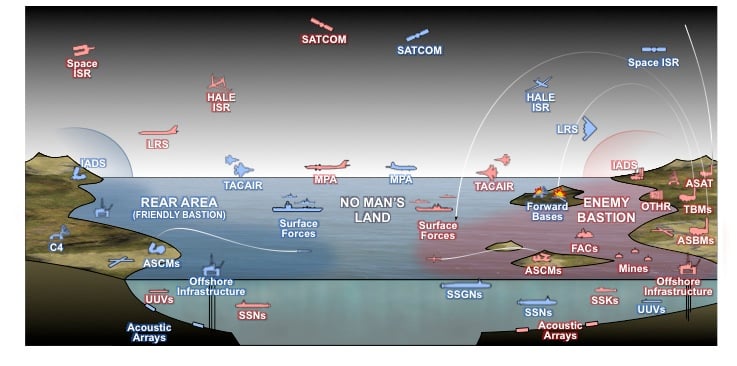
A notional future naval battle (CSBA graphic)

Serving the Navy

For decades, the Navy has helped Marines land and fight ashore — as far inland as Afghanistan. Now the Marine Corps wants to return the favor by helping clear the seas.

Even 10 years ago, the Navy didn’t need the help. Now it does. Regional powers like Iran threaten coastal waters with shore-based missiles and short-ranged but high-speed patrol boats. Near-peers like Russia and China boost their ocean-going battle fleets with submarines, destroyers, and even aircraft carriers.

“For the past 70 years, the US Navy has had undisputed sea control when it wanted. That’s no longer the case,” said Art Corbett, who works in the concepts division of the Marine Corps Warfighting Laboratory. For the Marines, he said, “the last time we fought for sea control with the Navy was the Solomons campaign” in 1942.

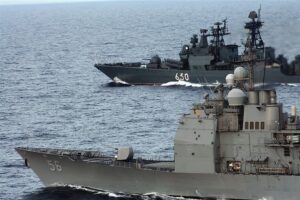
US and Russian warships

The two services’ joint concept for Littoral Operations in a Contested Environment (LOCE, pronounced “Loki”) is reviving this concept of Marines supporting the fleet. “Any time Marines are going to be pointing missiles seaward, we’re going to be doing this, probably, at the direction of and in coordination with the Navy,” Corbett said. “This is… a naval, networked capability.”

Sharing targeting data with the fleet, Marine Corps anti-ship missiles would be in many ways an extension of the Navy’s Distributed Lethality concept. Distributed Lethality seeks to upgun every possible platform at sea — “if it floats, it fights” — including lightweight Littoral Combat Ships and even currently unarmed auxiliaries, to multiply both the Navy’s options and an enemy’s problems.

The Marines would provide additional “distributed” firepower from Expeditionary Advance Bases. Carved out of hostile territory by landing forces, kept small and camouflaged to avoid enemy fire, EABs would support F-35B jump jets, V-22 tiltrotors, and drones, as well as anti-ship missiles for the fleet. It’s a high-tech version of Henderson Field on Guadalcanal (part of the Solomons) in 1942. Like Henderson Field, the EABs would provide a permanent presence ashore, inside the contested zone, to support Navy ships as they move in and out to raid and withdraw. The forces ashore are the anvil; the fleet is the hammer.

Shore-based anti-ship missiles wouldn’t be as mobile as ones on ships. But they might be more survivable. Islands don’t sink, after all. Plus, especially in jungle, mountainous, or urban terrain, the land provides far more hiding spaces for a truck-sized HIMARS than the open sea provides for a 400-foot-long ship. Once you launch a rocket, however, the enemy can see your location on radar and infra-red, so the missile batteries must practice “shoot and scoot” tactics: move to a firing point, launch, and move again to a hiding place before enemy retaliation rains down.

Executing such operations in practice, however, requires specialized and costly technology.

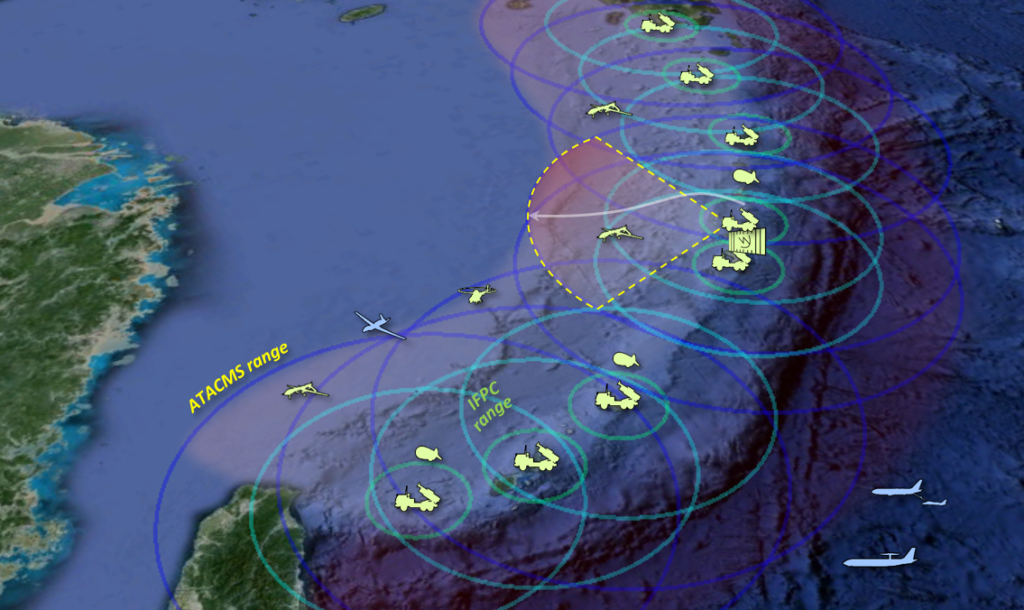
Land-based missiles fired from Expeditionary Advance Bases (EABs) could form a virtual wall against Chinese aggression (CSBA graphic)


Technology & Its Limitations

The good news is that lots of friendly countries already have shore-based anti-ship missiles. The bad news is they may not fit with how the Marine Corps wants to operate: mobile, flexible, and aggressive.

The Marine Corps Request For Information asks for the state of the art because “we know many nations around the Pacific, many in Europe…have all had this kind of capability for decades,” McConnell said. “We would like to make sure it aligns with the Marine Corps concepts of being expeditionary, being able to move at will and being transportable by a variety of means. That was the subject of the RFI.”

“Several nations…. have created this standalone capability,” McConnell said (emphasis ours). “They command and control the missile, the radars, the sensors, in a unit that (only) does that kind of mission, that is permanently oriented on — to use an old term — coastal defense.”

“That kind of exquisite solution” — tailored for a single mission — is probably too expensive and too inflexible for the Marines, McConnell continued. Neither the Marines nor the Army can create a whole new type of unit for “a niche capability,” he said. Instead, the goal is to add anti-ship capability to existing rocket artillery without taking away any of its current capabilities to strike targets ashore.

There are two ways to do this, said Joe McPherson, deputy program manager for fires (i.e. artillery) at Marine Corps Systems Command: “One is modifying our existing missiles and the other would be trying to attempt to bring in missiles that already do this mission.”


The LCS Coronado test-fires a new anti-ship missile from Norway’s Kongsberg.

Preferably, any new missile would be able to fire from the existing Army and Marine Corps launchers, the wheeled HIMARS and tracked MLRS. “I wouldn’t at this point exclude something like Raytheon-Kongsberg Naval Strike Missile,” said McConnell. “There is a potential that it’s capable of being modified to fire from a HIMARS.”

The Kongsberg NSM is competing for the Navy’s Over-The Horizon (OTH) weapon, which will go on the Littoral Combat Ship and future frigates. The Marines are working closely with the Navy, McPherson told me, and the specifications they’ve set are sufficiently close to the Marine Corps’ needs that “whatever missile they pick” is worth considering for a joint buy, which would significantly reduce costs.

Another potential joint buy is with the Army. In the short term, the Army and the Pentagon’s Strategic Capabilities Office are upgrading the ATACMS, the biggest missile the HIMARS and MLRS can launch, with a range of roughly 187 miles. The long-term solution might be the Army’s Long-Range Precision Fires (LRPF) missile, supposed to be be half the size with 67 percent more range.

However, the Marine Corps RFI only asks for “ranges of 80 miles or greater,” which means they are at least considering lighter, cheaper missiles that a unit could carry more of, trading range for staying power. The Marines are also willing to consider a less sophisticated and therefore less expensive warhead: one good enough to destroy small craft, like missile boats, and damage larger vessels, but probably unable to penetrate the defenses of a full-size warship with sufficient precision to deliver a killing blow.

Bryan Clark

“That might be the capability we end up with,” McConnell told me. “That might be enough.” (Especially, I might add, if Army units fire longer-ranged ATACMS or LRPF missiles from further back).

Would an 80-mile missile be useful? Absolutely, said Bryan Clark, a retired Navy commander now with the Center for Strategic & Budgetary Assessments. “The 80 (nautical mile) minimum range could be relevant in scenarios in the Persian Gulf, Mediterranean, and possibly the South China Sea,” all relatively narrow waterways, he said. “That would be enough to threaten ships beyond realistic ranges for enemy helicopters and assault craft to attack the EAB (in retaliation).”

The downside is that even an 80-mile missile would need a relatively large launcher, like the HIMARS, and despite having “High Mobility” in its name, Clark is not sure the 12-ton truck is mobile enough for Expeditionary Advance Base operations. (The tracked MLRS is more mobile over rough terrain but weighs 22 tons). “I hope responses to the RFI will address mobility of the fires launcher,” he said.

“The main thing we’re looking for is really what’s in the realm of the possible, both near-term solutions and far-term,” McPherson said of the RFI. Once the data comes back in December, the Marine officials said, they’ll look at their options and start work on an official requirement.


The Key to Success in War with Russia and China Could Be Missiles

For the foreseeable future, the United States and China are locked in a security competition. 

Here's What You Need to Know: Land-based missile batteries can threaten ships dozens or even hundreds of miles away.


Is There A War Brewing In The South China Sea?


Tensions in the South China Sea have been percolating for years now. Even in relatively calm times when the battling claimants of the contested waters manage to stay out of the headlines, the reality out on the sea is rarely tranquil. In fact, a recent report from the South China Morning Post has revealed that Chinese boats have been harassing Civilian vessels in the Malaysian and Vietnamese portions of the South China Sea “on a daily basis” for years.

Extending from Singapore and the Strait of Malacca in the southwest to the Strait of Taiwan in the northeast, the South China Sea is a geopolitical hotspot as one of the most important trade routes in the world, not to mention the home of valuable oil and gas reserves as well as lucrative fishing grounds. The United States Energy Information Agency (EIA) estimates that the South China Sea “contains approximately 11 billion barrels of oil and 190 trillion cubic feet of natural gas in proved and probable reserves.”

Huge, overlapping sections of the Sea are currently subject to claims by Brunei, China, Malaysia, Indonesia, the Philippines, Taiwan, and Vietnam. China has staked the largest claims to the South China Sea (at more than 85% of the total area) and has been the most aggressive in defending these claims, with a huge show of military might and navy vessels patrolling the waters. Last year, during another flare-up of tensions, the Asia Times reported that China’s most recent rash of aggressions was a bid to shut down Vietnamese resource development projects “as Beijing aims to force all foreign oil companies out of the South China Sea, leaving itself as the only potential joint development partner for rival sea claimants.”


Vietnam is far from Beijing’s only victim, however. Indonesian drilling has also been targeted in the so-called “Tuna Block” in the Natuna Sea, in the same waters where these two nations have clashed in the past over fishing rights. And now, according to the recent reports from the Asia Maritime Transparency Initiative, Malaysia has been bearing the brunt of Chinese bullying on a daily basis for the past two years. The Malaysian state-owned oil company Petronas has been developing several oil and gas fields in the Luconia Shoals, where Chinese vessels have been reportedly driving dangerously and erratically with the intention of dissuading civilians to take contracts in the area.


“Beijing’s competing claimants to territory in the South China Sea have long accused it of using a paramilitary maritime militia, consisting of hundreds of civilian fishing boats, to help enforce its claims,” The South China Morning Post reported this week. The Chinese government claims that these swaths of civilian fishing boats are not dispatched by the military, but that they join of their own accord, although many other governing bodies (including the United States) believe that the vessels are directly under the command of the People’s Liberation Army Navy.

An all-out oil war in the South China Sea would be extremely costly for China, and ultimately may not be in the country’s best interest. Invading another nation is costly, and in this region, the battle could easily turn into another kind of ‘forever war.” And then there’s the fact that China risks destruction in the very waters that it wants to claim, imperiling valuable infrastructure. There are a lot of reasons why China should not and likely will not push its competing claimants hard enough to start a war, and many more reasons that much lesser military powers like Malaysia and Indonesia should just grin and bear the abuse, but Beijing’s behavior over the past few years has shown that China is more than willing to test those boundaries.
Pentagon rattled by Chinese military push on multiple fronts


China’s growing military muscle and its drive to end America predominance in the Asia-Pacific is rattling the U.S. defense establishment. American officials see trouble quickly accumulating on multiple fronts — Beijing’s expanding nuclear arsenal, its advances in space, cyber and missile technologies, and threats to Taiwan.

“The pace at which China is moving is stunning,” says Gen. John Hyten, the No. 2-ranking U.S. military officer, who previously commanded U.S. nuclear forces and oversaw Air Force space operations.

At stake is a potential shift in the global balance of power that has favored the United States for decades. A realignment more favorable to China does not pose a direct threat to the United States but could complicate U.S. alliances in Asia. New signs of how the Pentagon intends to deal with the China challenge may emerge in coming weeks from Biden administration policy reviews on nuclear weapons, global troop basing and overall defense strategy.

For now, officials marvel at how Beijing is marshaling the resources, technology and political will to make rapid gains — so rapid that the Biden administration is attempting to reorient all aspects of U.S. foreign and defense policy.

The latest example of surprising speed was China’s test of a hypersonic weapon capable of partially orbiting Earth before reentering the atmosphere and gliding on a maneuverable path to its target. The weapon system’s design is meant to evade U.S. missile defenses, and although Beijing insisted it was testing a reusable space vehicle, not a missile, the test appeared to have startled U.S. officials.

What war with China could look like

Gen. Mark Milley, chairman of the Joint Chiefs of Staff, said the test was “very close” to being a Sputnik moment, akin to the 1957 launching by the Soviet Union of the world’s first space satellite, which caught the world by surprise and fed fears the United States had fallen behind technologically. What followed was a nuclear arms and space race that ultimately bankrupted the Soviet Union.

Milley and other U.S. officials have declined to discuss details of the Chinese test, saying they are secret. He called it “very concerning” for the United States but added that problems posed by China’s military modernization run far deeper.

“That’s just one weapon system,” he said in a Bloomberg Television interview. “The Chinese military capabilities are much greater than that. They’re expanding rapidly in space, in cyber and then in the traditional domains of land, sea and air.”

On the nuclear front, private satellite imagery in recent months has revealed large additions of launch silos that suggest the possibility that China plans to increase its fleet of land-based intercontinental ballistic missiles, or ICBMs.

Hans Kristensen, a nuclear weapons expert at the Federation of American Scientists, says China appears to have about 250 ICBM silos under construction, which he says is more than 10 times the number in operation today. The U.S. military, by comparison, has 400 active ICBM silos and 50 in reserve.

Pentagon officials and defense hawks on Capitol Hill point to China’s modernization as a key justification for rebuilding the U.S. nuclear arsenal, a project expected to cost more than $1 billion over 30 years, including sustainment costs.

Fiona Cunningham, an assistant professor of political science at the University of Pennsylvania and a specialist in Chinese military strategy, says a key driver of Beijing’s nuclear push is its concerns about U.S. intentions.

“I don’t think China’s nuclear modernization is giving it a capability to pre-emptively strike the U.S. nuclear arsenal, and that was a really important generator of competition during the Cold War,” Cunningham said in an online forum sponsored by Georgetown University. “But what it does do is to limit the effectiveness of U.S. attempts to pre-emptively strike the Chinese arsenal.”

Some analysts fear Washington will worry its way into an arms race with Beijing, frustrated at being unable to draw the Chinese into security talks. Congress also is increasingly focused on China and supports a spending boost for space and cyber operations and hypersonic technologies. There is a push, for example, to put money in the next defense budget to arm guided-missile submarines with hypersonic weapons, a plan initiated by the Trump administration.

For decades, the United States tracked China’s increased defense investment and worried that Beijing was aiming to become a global power. But for at least the last 20 years, Washington was focused more on countering al-Qaida and other terrorist threats in Iraq and Afghanistan. That began to change during the Trump administration, which in 2018 formally elevated China to the top of the list of defense priorities, along with Russia, replacing terrorism as the No. 1 threat.

Combined Russian and Chinese military power will approach, but not exceed US: report

For now, Russia remains a bigger strategic threat to the United States because its nuclear arsenal far outnumbers China’s. But Milley and others say Beijing is a bigger long-term worry because its economic strength far exceeds that of Russia, and it is rapidly pouring resources into military modernization.

At the current pace of China’s military investment and achievement, Beijing “will surpass Russia and the United States” in overall military power in coming years “if we don’t do something to change it,” said Hyten, who is retiring in November after two years as vice chairman of the Joint Chiefs of Staff. “It will happen.”

The Biden administration says it is determined to compete effectively with China, banking on a network of allies in Asia and beyond that are a potential source of strength that Beijing cannot match. That was central to the reasoning behind a Biden decision to share highly sensitive nuclear propulsion technologies with Australia, enabling it to acquire a fleet of conventionally armed submarines to counter China. Although this was a boost for Australia, it was a devastating blow to Washington’s oldest ally, France, which saw its $66 billion submarine sale to Australia scuttled in the process.

Taiwan is another big worry. Senior U.S. military officers have been warning this year that China is probably accelerating its timetable for capturing control of Taiwan, the island democracy widely seen as the most likely trigger for a potentially catastrophic U.S.-China war.

The United States has long pledged to help Taiwan defend itself, but it has deliberately left unclear how far it would go in response to a Chinese attack. President Joe Biden appeared to abandon that ambiguity when he said Oct. 21 that America would come to Taiwan’s defense if it were attacked by China.

“We have a commitment to do that,” Biden said. The White House later said he was not changing U.S. policy, which does not support Taiwanese independence but is committed to providing defensive arms.
Moral cowardice that keeps us from speaking our minds is as dangerous to this country as irresponsible talk. The right way is not always the popular and easy way. Standing for right when it is unpopular is a true test of moral character.....Margaret Chase Smith

Blog Archive